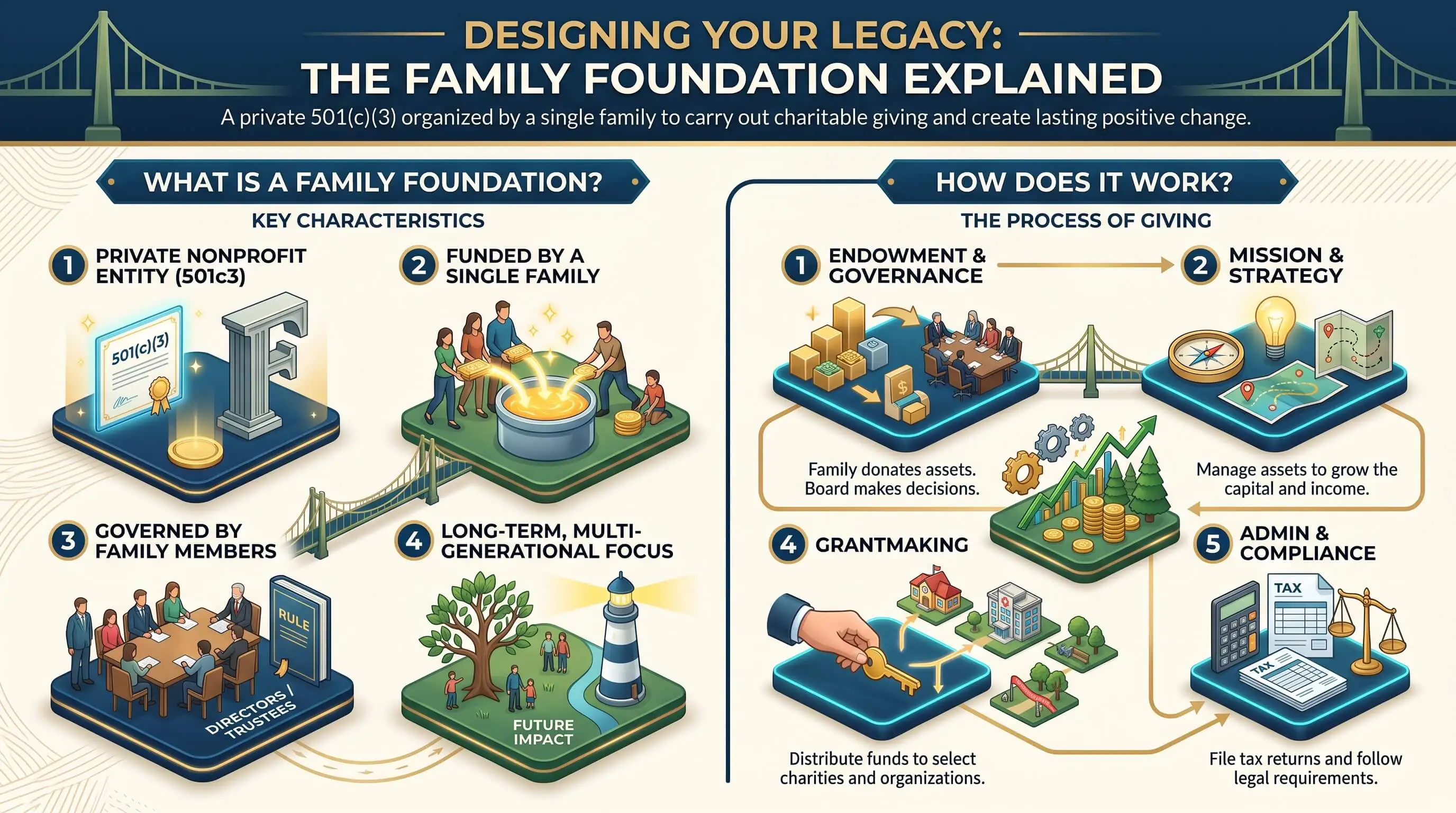
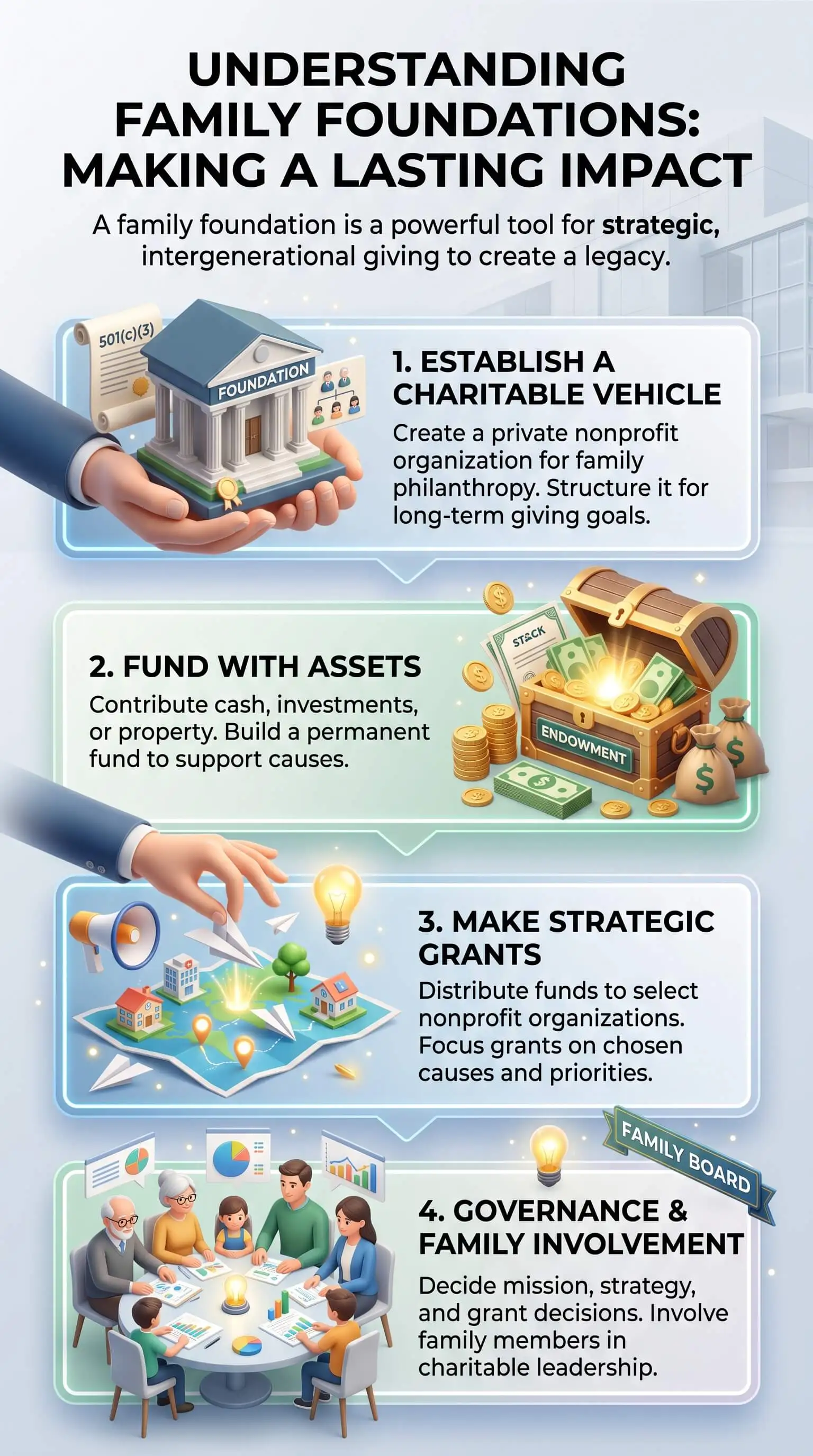
Most generous families hit a point where the checks outnumber the plan. A family foundation is one answer. It's a private foundation, tax-exempt under Section 501(c)(3), that one family funds and governs so its giving follows a mission instead of whatever request arrives next. A family-led board approves each grant, and the foundation reports its activity to the IRS every year.
Plenty of parents meet this world from the receiving end. Think of the tuition-assistance fund at your child's school, or the grant that finally paid for a new robotics lab. A good share of that money traces back to family foundations.
The foundations that last bring investment-level discipline to their giving, with the same care a family puts into its portfolio, supported by family office trust and business transition services that help align philanthropy with broader wealth, trust, and succession planning.
TL;DR Quick Answers
Family Foundation Management and Philanthropic Planning Services
Family foundation management and philanthropic planning services give a family one coordinated team to run its foundation and plan its giving. Grants follow a written mission, and the records stay clean all year. Your CPA and attorney remain the technical experts on tax and legal questions, while the planning team keeps everyone working from the same facts.
What these services typically cover:
Giving strategy: Clarifying the mission and grant approach, then timing gifts around your tax plan
Structure selection: Coordinating the choice among a private foundation, donor-advised fund, charitable trust or direct gifts with your advisors
Payout and compliance tracking: Watching the annual 5% distribution and keeping Form 990-PF information organized
Records and grant files: Keeping grant letters and board minutes in one place, ready for tax season
Governance and the next generation: Setting a board meeting rhythm and preparing adult children for a voting seat
Who benefits most: families with significant annual giving but no repeatable process, and families heading into a liquidity event or wealth transfer.
Top Takeaways
A family foundation is a private foundation that one family funds and governs to make charitable grants.
Each year it must distribute roughly 5% of its investment assets and pay a 1.39% excise tax on net investment income.
Self-dealing rules block most transactions between the foundation and its donors, board members or their relatives.
Next to a donor-advised fund, a foundation gives your family more control and more ways to take part, at the cost of more paperwork and less privacy.
Most families find the ongoing work harder than the setup, especially tracking the payout and keeping the CPA and attorney aligned.
Bringing the next generation onto the board early is what turns a foundation into a lasting family legacy.
A Family Foundation in Plain Terms
A family foundation stands apart from the family and its businesses as its own legal entity. It invests its assets and makes grants to public charities such as schools and hospitals.
You won't find "family foundation" defined in the tax code. The IRS treats it as a private foundation under Section 509(a), because most of its money comes from one source instead of the general public. What makes it a family foundation is who sits at the table: the founders and, over time, their children and grandchildren, serving as directors or trustees.
One detail surprises people. Every grant the foundation makes appears on its annual return, and anyone can look it up. If privacy matters to your family, weigh that early.
How a Family Foundation Is Structured
Most families set theirs up as a nonprofit corporation run by a board of directors, or as a charitable trust run by trustees. The founding paperwork usually covers:
A mission statement naming the causes the family wants to support
Bylaws or a trust agreement that set board size, terms and voting
A grant policy for reviewing and approving requests
A conflict-of-interest policy, which gets tested more often than families expect
Wealthier families often place the foundation inside a larger system run by a family office, the private team that handles investments, taxes, estate planning and day-to-day administration. In that setup, the foundation becomes one more entity that needs clean records and a steady calendar.
How a Family Foundation Is Funded
You can fund a foundation with cash, public stock, shares of a private company, real estate or other family assets. Some families make one large gift after selling a business. Others add a little every year for decades.
Expect less generous tax treatment than you'd get giving to a public charity. Deductions for gifts to a private foundation generally top out at 30% of adjusted gross income for cash and 20% for appreciated securities.
The 2025 federal tax law added two wrinkles starting in 2026. Itemizers can't deduct the first 0.5% of adjusted gross income they give, and filers in the top bracket get roughly 35 cents of tax benefit per itemized dollar. Have your CPA run the numbers before any major funding decision.
The IRS Rules Every Family Foundation Follows
Congress wrote these rules to keep foundation money working for charity, and it built the penalties to sting. Families run into these most often:
Minimum payout: Each year, the foundation has to distribute roughly 5% of its investment assets for charitable purposes. Fall short and the IRS charges a 30% excise tax on the gap, rising to 100% if the foundation doesn't correct it.
Excise tax: Foundations pay 1.39% on net investment income. A House proposal to raise that rate for larger foundations didn't survive into the final 2025 law.
Self-dealing: The foundation can't do most business with "disqualified persons," a group that includes major donors, board members and their relatives. That holds even when the deal would favor the foundation.
Business holdings and risky investments: Federal caps limit how much of a family company the foundation can own. It also can't make investments that put its charitable purpose at risk.
Scholarships: Paying scholarships straight to students requires grant procedures the IRS has approved in advance.
Annual filing: Every foundation files Form 990-PF. For calendar-year foundations, it's due May 15.
Family Foundation vs. Donor-Advised Fund
A donor-advised fund, or DAF, is the option most families weigh against a foundation. It sits inside a public charity sponsor, so the family handles far less paperwork but gives up legal control. Here's how the two compare:
Legal control: A family foundation's board makes every decision. With a DAF, the sponsor holds final authority and the family advises.
Setup: A foundation needs formation documents and an IRS application. A sponsor can open a DAF within days.
Annual payout: A foundation must distribute about 5% a year. A DAF has no federal minimum.
Deduction limits: Gifts to a foundation cap out at 30% of AGI for cash and 20% for appreciated securities. Gifts to a DAF allow 60% and 30%.
Privacy: Anyone can see a foundation's grants and assets. A DAF can send grants out anonymously.
Family roles: A foundation offers board seats, plus paid staff roles at reasonable compensation. A DAF offers advisory privileges only.
Scholarships to individuals: A foundation can fund them with IRS-approved procedures. A DAF generally can't.
Excise tax: A foundation pays 1.39% of net investment income. A DAF pays none.
Where Family Foundation Management Gets Hard
Setting up a foundation is a legal project with a finish line, while running one is a standing commitment, and that's where many families lose momentum.
The payout needs watching all year, not just in December. Grant letters and board minutes pile up fast. And your CPA and attorney need to work from the same facts, which rarely happens on its own.
The family side takes just as much care. Someone has to set the meeting rhythm and decide when adult children earn a seat on the board. Each generation will want its say in the mission, too.
We've watched this stage stall with more good intentions than any tax rule. Families who want the structure without carrying every detail often turn to multi-family office wealth management services to coordinate philanthropy with the family's broader wealth strategy while keeping grant tracking and board coordination organized alongside their legal and tax advisors. Your CPA and attorney stay the technical experts. Coordination keeps the giving on schedule, year after year.
"Families who get this right run the foundation like a small institution. Their boards meet on a set calendar, and they keep grant files as carefully as their investment statements. The best ones give adult children a real vote well before those children inherit the job. If I had to pick one habit, it's a written mission. Years from now, that page is what the grandchildren will read when they have to decide what the family stands for."
7 Essential Resources
IRS: Private Foundation Annual Return spells out who files Form 990-PF and what a late return costs.
IRS: Taxes on Failure to Distribute Income is the IRS's own explanation of the payout requirement and the penalties for missing it.
Council on Foundations: Family Foundations gives the field's working definition and shows how families usually govern their foundations.
National Center for Family Philanthropy: Trends 2025 shares survey data on how family foundations give and how they bring in the next generation.
Fidelity Charitable: What Is a Private Family Foundation? is worth reading if you're choosing between a foundation and a donor-advised fund.
Council on Foundations: One Big Beautiful Bill Impact on Philanthropy sorts out what the 2025 tax law changed for foundations and what it left alone.
Tax Foundation: Changes to Charitable Giving explains the 2026 deduction floor and cap that affect anyone funding a foundation.
Supporting Statistics
71% of family foundations give more than the required 5%. That's up from 55% in 2015 and 56% in 2020, according to the National Center for Family Philanthropy's Trends 2025 report, as covered by The NonProfit Times. Most families treat the 5% as a starting line.
47% of family foundations hold more than $10 million in assets. Read the same NCFP Trends 2025 data the other way and just over half run on less. A massive endowment isn't a prerequisite.
About half of all U.S. private foundations are family foundations. Fidelity Charitable cites the Council on Foundations for this figure.
Final Thoughts
Here's where I land. A family foundation is one of the best tools a family has for giving with clarity and intention, and one of the easiest to underestimate.
The legal setup rarely trips anyone up. Trouble tends to arrive around year three, when the payout needs tracking during a busy quarter and the board meeting keeps sliding. Records end up scattered across inboxes.
The foundations that hold up write their mission down and keep the grant calendar right next to the tax calendar. They also hand the next generation real responsibility early, before it lands on them by default.
A foundation isn't the right fit for every family. If your giving is modest, or you'd rather keep it simple and anonymous, a donor-advised fund may serve you better. For families who want control over their giving and a way to show their children what the wealth is for, though, a well-run foundation supported by outsourced family office executive services is hard to beat.
Frequently Asked Questions
How much money do you need to start a family foundation?
There's no legal minimum. The real test is whether your giving justifies the cost of formation and the ongoing administration, including the annual Form 990-PF. Families giving smaller amounts often find a donor-advised fund simpler, so ask your tax advisor to compare both for your situation.
Can family members be paid by a family foundation?
Yes, within limits. A foundation can pay family members reasonable compensation for work its charitable purpose actually requires. If it pays above market rates or covers personal expenses, the IRS can treat that as self-dealing and charge excise taxes to the family member and any board members who approved it.
What happens if a foundation misses the 5% payout?
The IRS charges a 30% excise tax on the amount the foundation didn't distribute. If the foundation still doesn't correct the shortfall, a second tax of 100% can follow. Paying the tax doesn't erase the obligation, either. The foundation still has to make the missed distributions.
Is a family foundation better than a donor-advised fund?
It depends on what your family values most. A foundation gives you legal control and lets family members hold board seats. It can also fund scholarships directly. A donor-advised fund comes with higher deduction limits and lower costs, has no required payout, and lets you give anonymously.
Can children serve on a family foundation board?
Adult children can serve as directors or trustees, and many families use board service to prepare the next generation. Younger members often start on a junior board or grant committee. There, they learn how the family weighs requests before they take a voting seat.
Can a family foundation fund scholarships or a private school?
Yes. A foundation can make grants to a private school that qualifies as a charity, whether for tuition assistance or a building project. It can also pay scholarships directly to individual students, but only with grant procedures the IRS has approved in advance.
Ready to Align Your Giving With Your Values?
Start with why before how. Write down the causes your family cares about and the role you want your children to play. Then take that page to your CPA and attorney, and choose the structure that fits the mission rather than the other way around.
For a lot of families, giving starts close to home, at the schools their children attend. If education is part of your mission, it helps to know how families afford private schools in California and why so many private schools depend on philanthropy to keep tuition within reach.